
SIP19 prints and delivers branded merchandise and textiles for franchise networks from its workshop in Marne-la-Vallée, near Paris. Since July 2026, we have managed the WordPress showcase site for its E-boutique offer: four pillar pages, structured data, more than forty articles checked before publication and monitoring of AI crawler access.
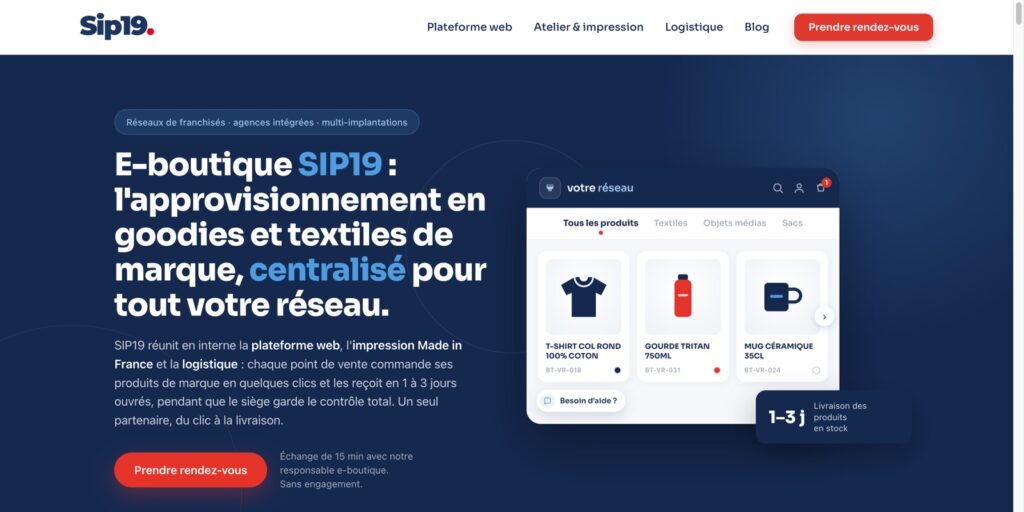
SIP19 brings three trades under one roof: an online ordering platform, a printing and branding workshop, and in-house logistics. Its E-boutique offer is aimed at the head offices of franchise networks, company-owned branch networks and multi-site businesses.
The showcase site had two jobs: present the offer and become a source of leads through generative engines such as ChatGPT, Claude, Perplexity and Gemini. At the outset it had only a few pages, and its home page carried a generic title with no meta description. One rule was set from day one: no prices anywhere on the site, and every call to action leads to a fifteen-minute meeting.
We structured the site around four pillar pages: the home page, the e-boutique platform, the branding workshop and integrated logistics. The three topic pages went live in July 2026. Each one opens with a direct answer, then unfolds through headings phrased as questions.
All of the content is present in the HTML sent by the server and readable without JavaScript. Interactive elements, such as the selector for the eight branding techniques or the order journey, keep their text in the page instead of loading it afterwards. A crawler therefore reads exactly what a visitor sees.
We built an editorial plan of 59 pieces of content across seven topic clusters, from the problems a head office faces to comparisons of solutions. Each cluster links to its pillar page, and each pillar page links back to its key articles, so engines can tell which page is the reference on which topic.
Drafts are written with an AI writing tool, then run through a checker we built. It blocks any price or amount, requires question headings and answers of 40 to 55 words, checks that the visible FAQ and its markup match, and verifies the links to the pillar page. A human editorial pass then adds real-world examples.
A weekly routine prepares the week’s articles and updates internal links on the day they go live. The blog now has more than forty published articles.
Reading the robots.txt file is not enough. An automated monitor queries the site twice a day under the identity of generative engine crawlers and compares their responses with a browser’s.
The offer is also presented in a 50-second video that we produced. It has its own watch page, with a transcript and chapters, and a dedicated video sitemap, so it can be indexed just like text. Articles are signed by a real author, presented with their role.
It is a rule set at the start of the project: no prices or amounts, in pages or in articles. Our checker blocks any article that contains one. Every call to action leads to a fifteen-minute meeting with SIP19’s e-boutique manager.
Drafts are produced with an AI writing tool, based on a knowledge base about SIP19. They are only published after our automated check and an editorial pass that adds real-world examples and verifies the facts. Every article is signed by a real author.
It is the reference page for a topic: the web platform, the branding workshop or logistics. Articles in the same cluster link to it, and it links back to their key articles. This internal linking tells engines which page best answers which question.
By querying the site under its identity, not just by reading robots.txt. A block can come from a firewall or a server rule that never appears in that file. Our monitor runs this check twice a day on SIP19’s site and reports any difference.
Working on a similar project? Let’s talk: we will come back to you with a first, concrete opinion on your needs.
Our mission:
Become your digital partner for sustainable, high-performance web platforms.
All rights reserved. Powered by Wellsy 🚀 | Legal notice | Terms of Sale | Privacy policy
 EN
EN  FR
FR